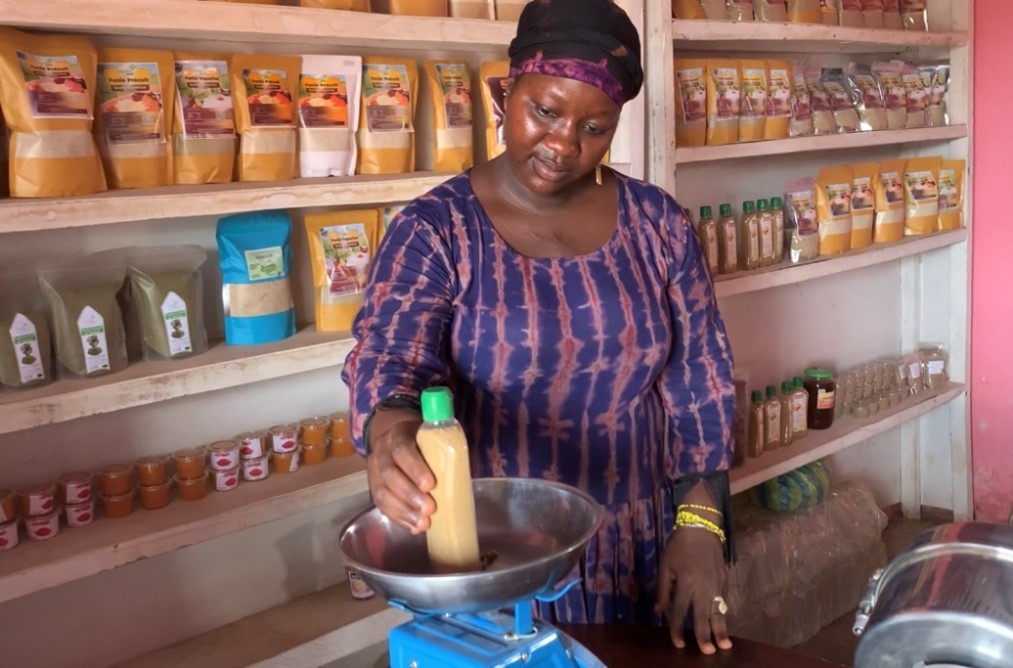
It was during her internship in the analysis laboratory of the regional hospital in Labé, Guinea, that Aissatou Amadou Baldé first envisioned her mission to create social and economic impact through the development of local resources.
In fact, Baldé’s path took a defining turn during that period, balancing an internship in an analysis laboratory with dedicated work for a non-governmental organization (NGO) where she was tasked with identifying processing companies.
It was in the very act of understanding these businesses, of seeing the industry’s inner workings firsthand, that a realization struck: the capacity to not just observe but to create opportunities. This moment ignited a passion for agri-food entrepreneurship, a spark that had been quietly glowing since her university days.
“Agribusiness is an essential lever for fighting poverty, creating jobs, and achieving food self-sufficiency.”
Aissatou Amadou Baldé
Baldé had the idea to transform ginger, a popular local product, into handmade syrup. In 2019, she took that courageous leap. With no capital to their name, the journey began with immense faith and the unwavering support of her husband.
He believed in her nascent vision, providing the crucial initial 50,000 CFA francs (Approx. $89.34 U.S.) — a modest sum that represented everything needed to transform an idea into action, building from scratch. She began selling her handmade ginger syrup in her town and from that solitary start, the venture blossomed. This small business grew and became a vocation very quickly, and she decided to structure her project and open a shop.
This is how Kakouma Agro-Tech, a company specializing in processing local agri-food products, was born. What began with two people has organically grown to provide four direct jobs and fifteen indirect jobs, breathing vital economic life into the community.
But Baldé’s impact extends far beyond mere job creation. From ginger, fonio, okra, and natural juices to chili powder, baobab leaves, dried mango, and more, Baldé’s range of products has expanded over the years, as has the company’s reputation and presence.
For Baldé, “Agribusiness is an essential lever for fighting poverty, creating jobs, and achieving food self-sufficiency. We process and ship our products throughout Guinea and abroad. We now have a Facebook page and WhatsApp business, and in 2022 we won the best agri-food award at the Saden Prize competition (Guinea’s entrepreneurship fair).”
Her commitment and rigor have opened the door for her to join the Agricultural Value Chain Development Project in Guinea (PDCVA-G), whose training component is managed by IFDC.
As part of PDCVA-G, Baldé completed all IFDC’s training courses, including soil fertility management, agribusiness, and marketing. Thanks to this training, she launched off-season farming to ensure a regular supply of raw materials, laying the foundations for an integrated and sustainable value chain. She came to understand that “transformation cannot happen without control over agricultural production and a marketing strategy.”
Today, Baldé is no longer just an entrepreneur. She has become a trainer in leadership, entrepreneurship, and personal development, sought after by several NGOs and youth support programs. Her business is a model of inclusive success, driven by a clear vision: to make agribusiness a lever for social transformation.
For four consecutive years, aspiring young professionals from the Dalaba Institute and the University of Labé have been welcomed as interns at Kakouma Agro-Tech, gaining invaluable hands-on business experience and skills on-site.
Baldé’s enterprise delivers crucial training programs, equipping young people and women with essential skills in leadership, personal development, entrepreneurship, and the practical processing of local products.
“My internship was a decisive experience, particularly thanks to the insightful advice of Aissatou Amadou Balde. Her expertise was crucial in helping me overcome the technical challenges related to incorporating an unconventional flour into traditional pastry for my thesis. Her guidance directly contributed to the success of my research on formulating a Madeleine cake enriched with plantain flour. This experience concretely strengthened my skills in product innovation and quality control,” shared Mamadou Bailo Balde, a Student in Food Product Technology and Control, at the Higher Institute of Veterinary Medicine and Science of Dalaba (ISSMV).
Baldé’s journey shows what is possible when knowledge, vision, and training come together, turning a single business into a catalyst for change and inspiring a new generation to see agriculture and agribusiness not just as work, but as a powerful force for community growth and lasting prosperity.
The Agricultural Value Chain Development Project in Guinea (PDCVA-G), funded by the Islamic Development Bank (IsDB) and implemented in collaboration with Guinea’s Ministry of Commerce, Industry, and Small and Medium Enterprises, is a five-year program (2021-2025) based in the Republic of Guinea with the primary objective of developing a sustainable agriculture sector by facilitating the transition from subsistence farming to a viable market-oriented system.