Download KeFERT Roundtable Final Report
Objectives
- Review major constraints to farmer access and use of fertilizers and soil amendments (particularly lime).
- Reach a consensus on the need to address these challenges through formation of a multi-disciplinary platform.
Background
His Excellency the President, Uhuru Kenyatta, established the government’s “Big Four” pillars, including 100% food security, as government priorities. Kenya’s Vision 2030 identifies the agricultural sector as one of the key sectors to deliver the 10% annual growth rate envisaged under the economic pillar. The Agricultural Sector Development Strategy 2010-2020 (ASDS) focuses on the challenges of food security, poverty reduction, employment creation, and transforming agriculture from subsistence to farming as a business.
In spite of increased fertilizer use trends, smallholder farmer yields remain stagnant and well below what is obtained by many commercial farmers, some of whom are achieving 10-15 metric tons per hectare (Mt/ha) maize yields. Overall, yield averages have stagnated at 1.7 Mt/ha, indicating low smallholder yields in spite of a 65% increase in fertilizer use from 2014 to 2017. While crop management factors play into this yield gap, non-use or low rates of fertilizer use by smallholders are keeping yields stagnant. Soil acidity, due to inherent soil factors, fertilizer acidification, and lack of corrective liming, further suppresses yields in many parts of Kenya. Smallholders use primarily NP fertilizers on maize (DAP or 23:23:0, CAN, and urea), yet deficiencies of other nutrients, including potassium, sulphur, calcium, magnesium, and micronutrients (particularly zinc and boron), are constraining yields. While some Kenyan and international fertilizer companies are producing balanced multi-nutrient fertilizers, no national nutrient deficiency maps exist to assist companies to better develop and target fertilizers according to varying soil and crop requirements. Balanced fertilizer providers face competition from subsidized fertilizers, such that farmers are reluctant to purchase appropriate fertilizers at market prices.
Unblocking these constraints, providing extension demonstrations and messaging for increasing farmer awareness, developing efficient distribution networks, and financing key investments can accelerate the development and distribution of better fertilizers and lime products. Such an effort requires coordination of the multiple fertilizer sector actors: fertilizer and lime suppliers, policymakers, fertilizer regulatory bodies, laboratory services, experts in geostatistical information collection and mapping, and research and extension entities (both government and non-government).
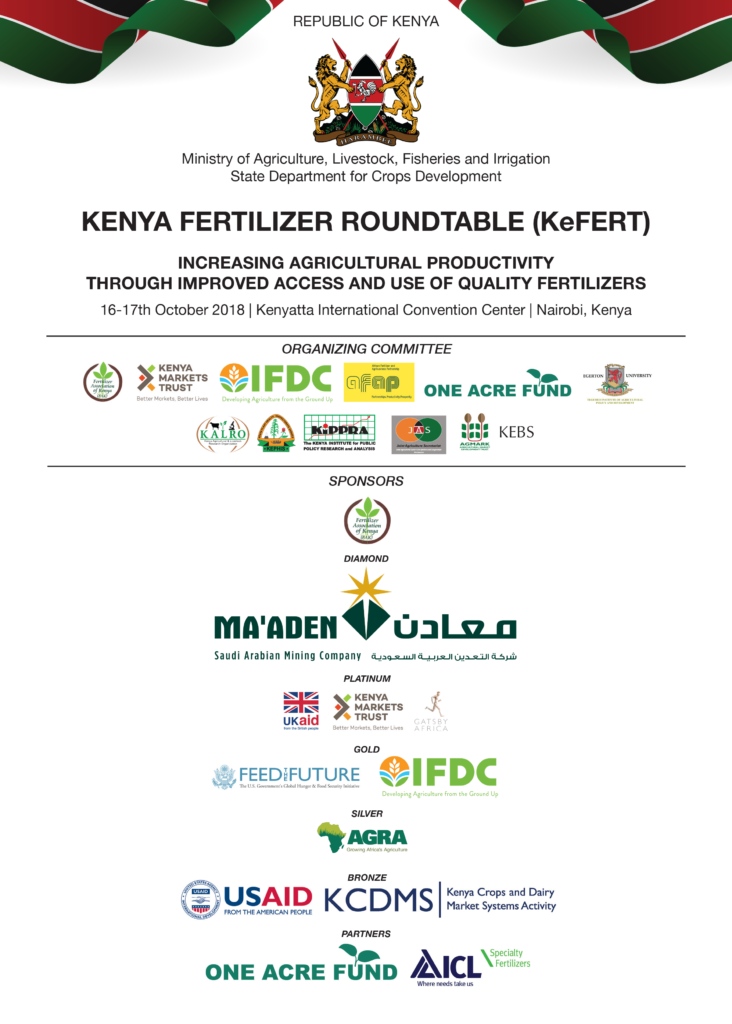
To facilitate this coordination, the Ministry of Agriculture, Livestock Fisheries and Irrigation (MoALF&I), in collaboration with various public and private partners, has organized this roundtable meeting, bringing together fertilizer stakeholders. This roundtable builds on previous fertilizer roundtables held between the late 1990s and 2011.
Media Coverage
Kenya Fertilizer Platform
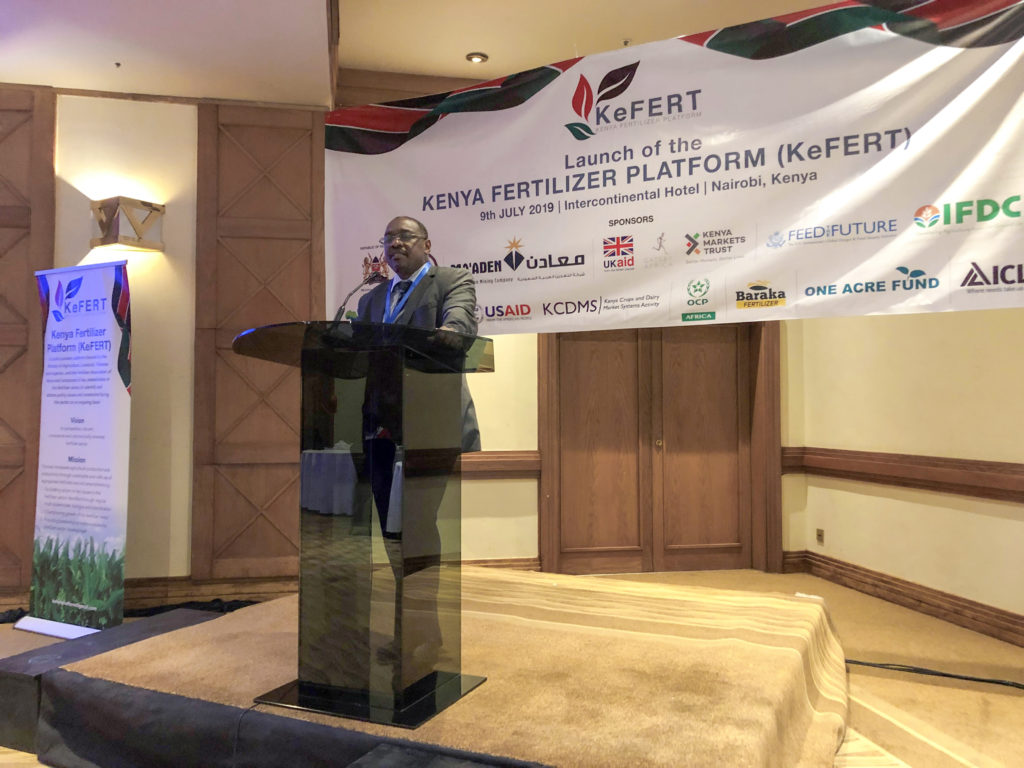
The proposed Kenya Fertilizer Platform is a public-private mechanism composed of key stakeholders involved in fertilizer access, quality, and use, whose purpose is to resolve issues and enable dialogue, coordination, and information exchange. The Fertilizer Platform is intended to facilitate action on key fertilizer issues through multi-stakeholder dialogue and public-private task forces on an ongoing basis. A key outcome of this platform is increased accessibility, affordability and availability of fertilizers to smallholder farmers as a result of a more competitive fertilizer sector.